Teaching Decision-Making with Branching Scenarios
Some things can’t be taught by telling. You can explain what good judgement looks like, but learners only really build it by making decisions and living with the results. That’s what a branching scenario does: it drops learners into a situation, asks them to choose, and shows them where that choice leads. Here’s how to make one that teaches.
Start with a decision that matters
A scenario is only as good as its dilemma. The opening situation should present a genuine trade-off with no obviously correct answer — an ethics call, a safeguarding judgement, a customer complaint, an incident response. If the “right” choice is obvious, there’s nothing to learn.
Make every branch plausible
Each option should be something a reasonable learner might actually pick. The goal isn’t to trick people into a single correct path; it’s to let them explore the consequences of different reasonable-sounding choices. Weak, throwaway options waste a branch.
Let consequences do the teaching
Don’t mark a choice “wrong” and move on. Show what happens next — the follow-on situation, the new problem it creates, the door it closes. Consequences that unfold naturally teach far more than a red X ever could.
Play it as a team
Scenarios come alive when a group has to agree on a decision. The argument before the choice — weighing options, surfacing assumptions — is where much of the learning happens. One shared run per group keeps everyone in the same story.
Debrief with the decision map
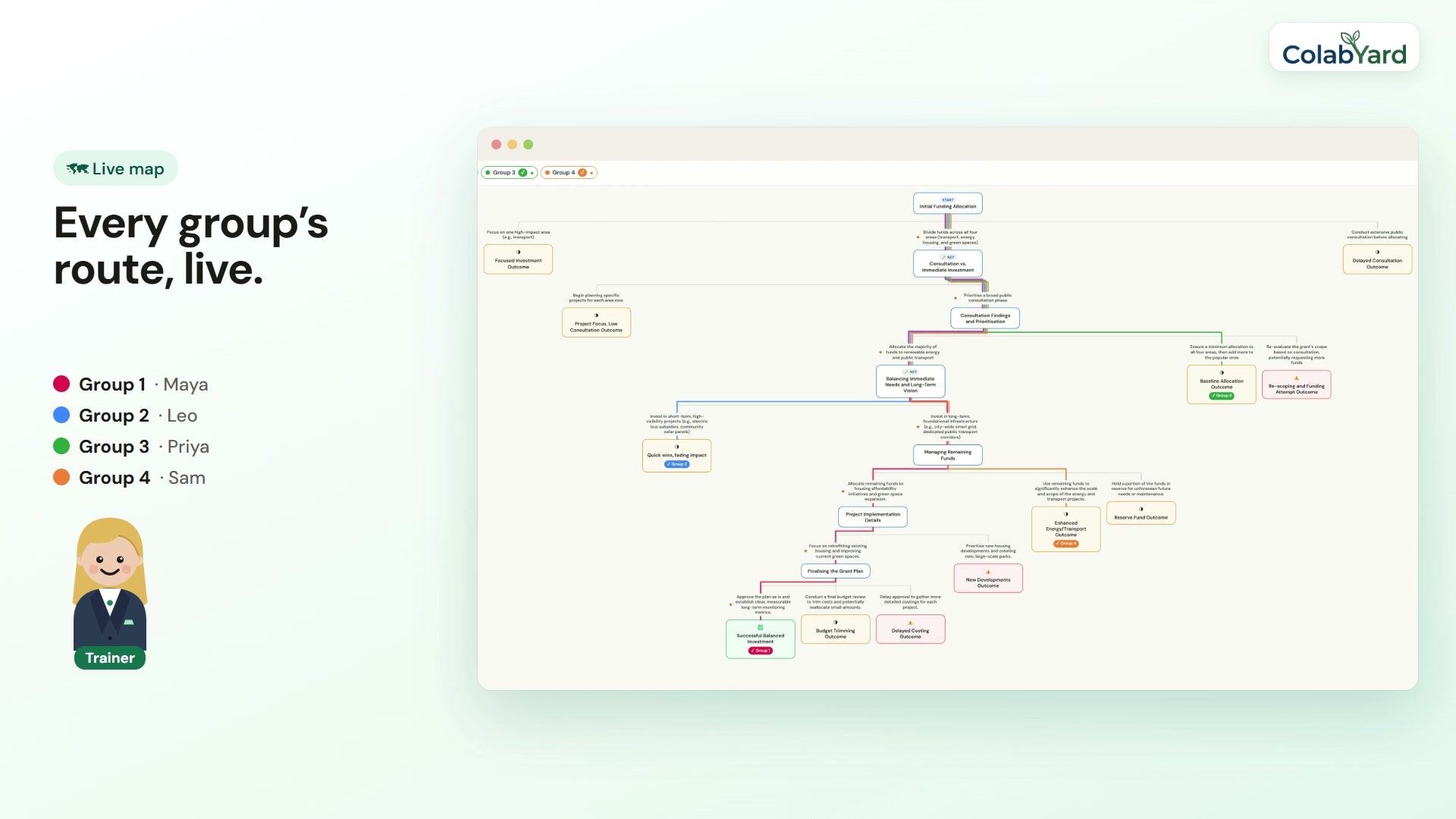
Afterwards, show each group the path they actually took. Comparing routes across groups — “why did you go left here when they went right?” — turns individual choices into a rich whole-class discussion about judgement itself.
How to write one, step by step
- Pick the judgement you want to build. Not a topic — a judgement. “When to escalate a safeguarding concern” is a scenario; “safeguarding” is a syllabus.
- Write the ending you’d like and the two you wouldn’t. Knowing the good outcome and the realistic bad ones tells you what the branches have to lead to.
- Set the opening scene with a role and some pressure. “You are the duty manager. It’s 4:50 on a Friday.” Learners decide differently when they are someone, somewhere, short of time.
- Give two or three options at each point — each one something a sensible person might do.
- Write what happens next, not whether it was right. The consequence carries the feedback.
- Play it yourself, taking the worst options. If the bad route is dull, learners who take it learn nothing.
How big should the tree be?
Smaller than you expect. Three or four decision points with two or three options each is enough for ten to fifteen minutes of play and a proper debrief. The mistake is letting every choice open a completely new story — the tree doubles at every step and you end up writing dozens of scenes nobody will see. Let branches rejoin: different choices can lead to the same next situation, arriving in better or worse shape.
Keep score of the things that matter
Real decisions rarely fail on a single choice; they wear something down. A running score — budget left, a client’s trust, the level of risk — makes that visible. Each choice nudges the totals, learners watch them move, and the ending can depend on where the totals finish rather than only on the last choice. It teaches the thing that is hardest to say in a lecture: a decision that looks fine on its own can be the third small cut.
Scenario, case study or role play?
| Format | Learners… | Best for |
|---|---|---|
| Case study | Analyse what someone else did | Seeing a whole situation with hindsight |
| Branching scenario | Choose, and face the consequence | Practising judgement where options are known |
| Role play | Say what they would actually say | Conversations: complaints, feedback, difficult news |
They combine well. A case study sets up the background, a branching scenario puts learners inside it, and a role play rehearses the one conversation the scenario turned on.
Where scenarios earn their place
- Health and social care: prioritising, escalation, consent, a worried relative.
- Business and management: a complaint, a budget cut, a team member underperforming.
- Cyber security and IT: an incident unfolding with incomplete information.
- Education and safeguarding: a disclosure, a behaviour incident, a concern about a colleague.
- Law and ethics: conflicts of interest, where every option has a cost.
With ColabYard’s guided scenarios, you describe a situation and AI drafts the full branching tree — which you then edit before it goes live. Groups play one shared run and replay their route on a decision map, a natural lead-in to a group discussion.
Frequently asked questions
What is a branching scenario?
A learning activity built as a decision tree. Learners read a situation, choose what to do, and the story continues differently depending on the choice. It is used to practise judgement, because learners see the consequences of a decision rather than being told whether it was correct.
How long should a branching scenario be?
Three or four decision points is usually enough: about ten to fifteen minutes of play, leaving time to discuss the routes people took. Longer trees take far more writing and the debrief gets squeezed out.
Should there be one right path through a scenario?
Not necessarily. Scenarios teach most when several options are defensible and lead to different trade-offs. It helps to have a clearly better outcome and some realistic worse ones, but the options along the way should all be things a reasonable person might choose.
Can a branching scenario be assessed?
It can be scored, for example with running totals for budget, trust or risk, and the route each group took can be reviewed afterwards. It is generally best used formatively: the discussion about why a group chose a route is worth more than the score.
Watch it in action
Try it with your own learners
ColabYard is free for trainers. No student accounts needed — just a QR code.
Get started free →